Honolulu project brief
Design Challenge
Since COVID, cities have encouraged merchants and business operators to use outdoor spaces to buffer the economic storm. The Mayor’s emergency order now allows for temporary sidewalk dining. Prior to the pandemic, the City also launched a Parklet program, allowing business owners to utilize street parking spaces for additional seating and landscape areas. While new opportunities have emerged, there are not many businesses taking advantage of the outdoor dining and retail opportunity, and even fewer services moving their operations outside. We want to encourage people to rethink the use of sidewalks, street parking for parklets, streets, and public and private parking lots for new uses. We want to visualize possibilities that will inspire business owners to take advantage of the Mayor’s emergency order and to support long term policy changes that would allow for permanent outdoor operations. Thinking about this typologically, a majority of our retail and dining establishments are located behind large parking lots in strip malls. How can we envision an evolution of this typology that is attractive to property owners and beneficial to the public? We have very narrow sidewalks and a climate that demands shade. Many business owners are concerned about vagrancy and vandalism. On top of that, they have very little cash on hand to fund any improvements. The embrace of the outdoors is not without its deterrents. We invite your thoughts and approaches to these challenges.
Policy Challenge
The Mayor's emergency orders now present an opportunity to update existing policies. How have other cities moved from COVID orders to more permanent policies? What kind of processes did they go through? What kinds of programs or policies did they adopt to expand business operations outdoors? What can we learn from them? How can we increase interest in the Parklet program via policy or communications adjustments? How might we also rethink the periphery of the public realm, at the face of our buildings? How might this new demand for indoor-outdoor space and natural ventilation inspire new policies that encourage more permeable building facades? What are the opportunities and roadblocks to encouraging more open-air design?
Desired outcomes and deliverables
Design
Street parking and sidewalk condition:
Identify a street parking location in your site vicinity to demonstrate immediate low cost, mid term, and long term modifications to both the stall and sidewalk area. Please note any best practices, considerations, or policy requirements that relate to your design approaches if applicable.
(3) drawings, 1 per time frame (immediate, mid term, long term) with rough dimensions, approximate costs. Site plan and/or diagrammatic axon.
Parking lot condition:
Identify improvements to a large parking lot in your site area that would support businesses and improve the public experience. Single or multiple approaches are welcome.
(1) Site plan and diagrammatic axon.
Policy
Parking and street frontage policies:
Identify precedents where expanded use of streets and underutilized open space for business and other uses have been integrated into policies and long term programs. Provide actionable steps toward policy changes here in Hawai’i.
Permeable facades:
How can we rethink policies and design guidelines to incorporate more indoor-outdoor connectivity and passive ventilation into building facades. Identify roadblocks and recommendations for future updates to the LUO, Special District documents, or other guidelines. Provide diagrams as applicable.
Honolulu project sites
“Urban Honolulu is transforming. In accordance with smart growth principles and transit oriented development, the city is concentrating future development within Honolulu’s urban growth boundary and in proximity to future rail stations. This densification will require a sustainable transportation network within the urban core, including transportation alternatives for those that can’t or don’t wish to use a car for all of their daily trips. With this transformation, Honolulu can realize the social, economic, and environmental benefits of becoming a more safe and walkable city. Through its complete streets program, the City and County of Honolulu is committed to implementing complete streets solutions that improve safety, accessibility, and comfort for all users, encourage physical activity, and reflect community needs and character.”
-Honolulu Urban Core Complete Streets
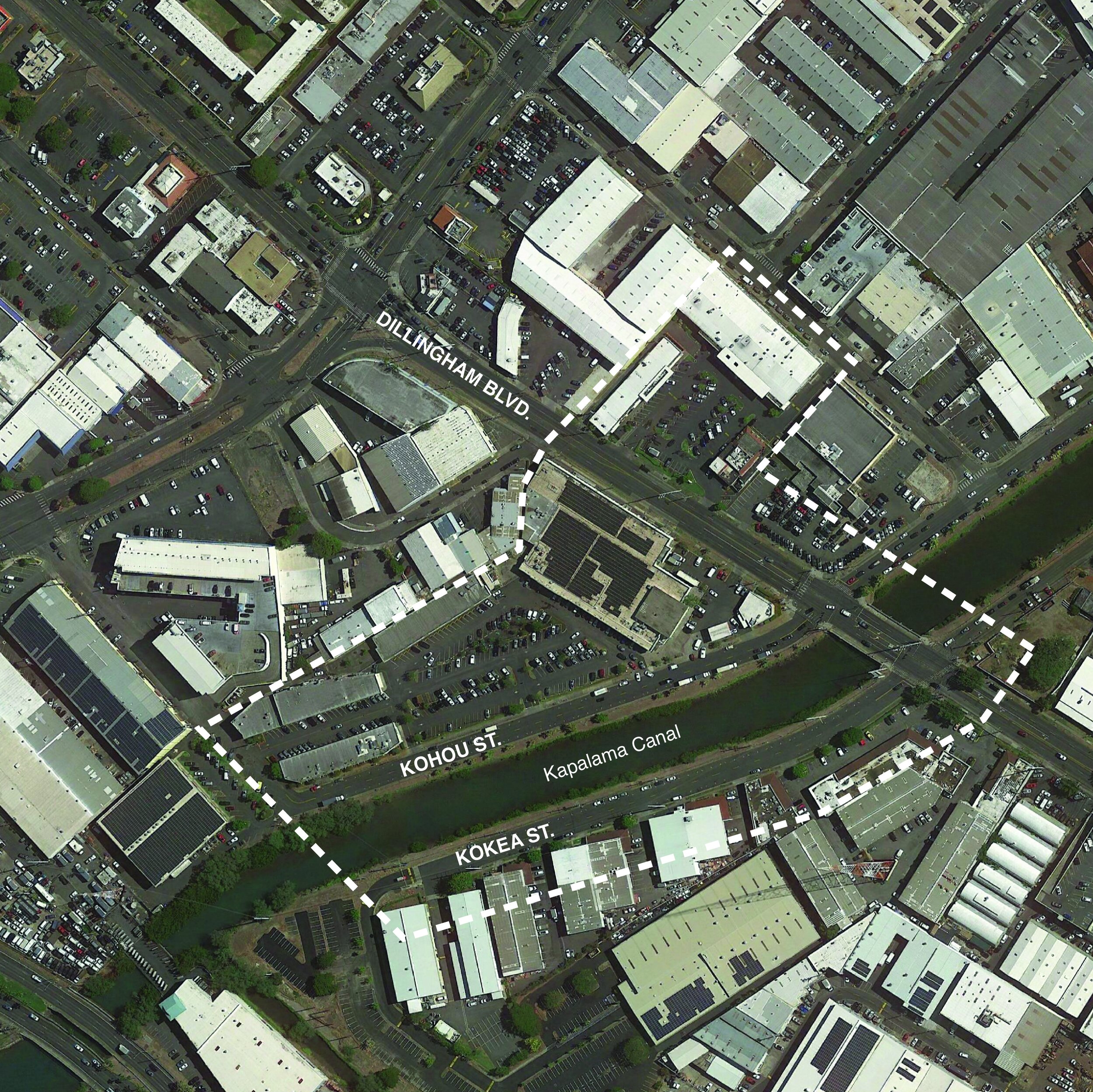
Site #1 Kalihi/Kapālama
“Kalihi is one of the most diverse communities in Honolulu. It hosts a range of small commercial and industrial businesses and serves as a home to long-time residents and new immigrants. With the planned introduction of three rail transit stations (Middle Street, Kalihi and Kapālama), Kalihi has the opportunity to emerge as a vital mixed-use district, with a new neighborhood in Kapālama, more diverse housing and employment opportunities, reinvigorated educational centers, new open spaces, a promenade along Kapālama Canal, and a multi-modal circulation network connecting residents and workers to key destinations, homes, and jobs. The Kalihi Neighborhood TOD Plan will guide development over the next era of Kalihi’s growth and enhancement.”
-Honolulu Transit-Oriented Development
The Kalihi Kapalama site includes 2 large and 1 mini strip malls that reflect a common retail typology in Honolulu, one with a large stream side frontage, the other with a crowded boulevard frontage. This site offers the strip mall (its street frontage, parking lot, and storefront) as a space for policy and design exploration, sensitive to the needs of property owners, but responsive to the desire for welcoming, walkable, and resilient urban space.
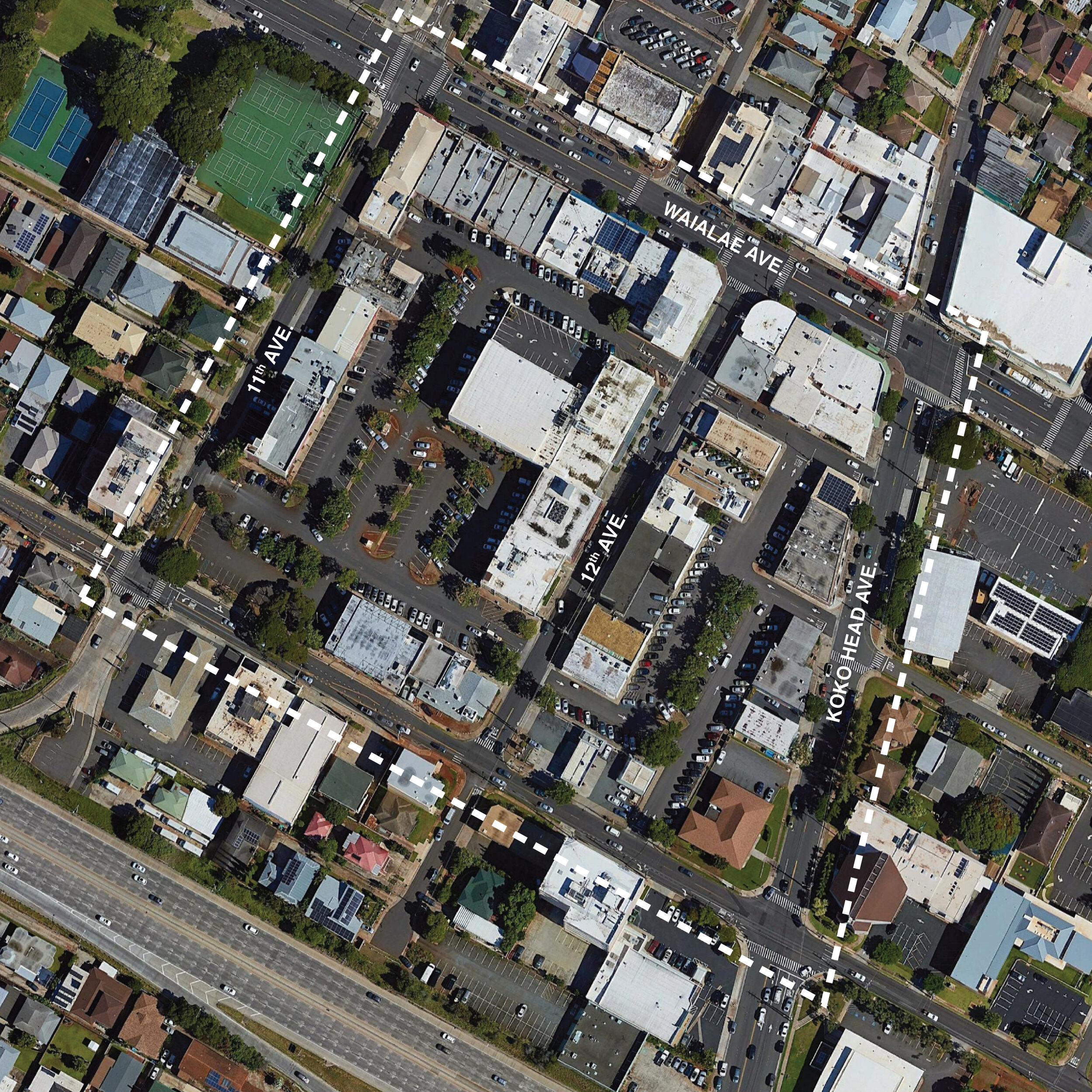
Site #2 Kaimukī
“Kaimukī is a classic early twentieth century neighborhood on the Koko Head side of downtown Honolulu. Kaimukī means ‘tī oven’, a reference to the legend of the Menehune cooking tī roots in the area. Kaimukī is a naturally dusty, dry area that was not heavily populated during pre-contact times because of a lack of water. The only spring known today is on Luakaha Street near the Salvation Army.”
-Jill Byus Radke for Historic Hawaiʻi Foundation
The Kaimukī site consists of two privately owned blocks central to the Kaimukī commercial town center, bounded by 11th Ave and Koko Head Ave, and Waialae Avenue, the commercial corridor for the neighborhood. These two blocks are a busy commercial, retail, and dining hub for the community. Both blocks have internal parking lots that access the back entries of the commercial spaces. A few parklets have been proposed for this area (see web link below). 12th Avenue is a smaller street could be used as an “open street”.
Project resources
All project resources listed below are available for download. Please click on the button below to download the files.
Planning documents
Mayor’s Emergency Order: effective Friday, June 5, the City will allow restaurants and other eateries to set up temporary sidewalk dining on City property.
2019 Transit Oriented Development Special District, Design Guidelines
2017 Kalihi Neighborhood Transit -Oriented Development (TOD) Plan.
2016 Parklet Program Guide (C&C of Honolulu, DPP, DTS)
2016 Complete Streets Ordinance
2016 Complete Streets Design Manual (C&C of Honolulu)
Other environmental/historic/cultural background
2020 Draft EIS Kapalama Canal
2016 Kapalama Canal Catalytic Project Existing Conditions Report
2001 Kaimuki Traffic Calming Project Environmental Assessment
Place name research - translations for nearby Hawaiian street/place names
Community engagement
2020 Design Tank Community Survey Data Report
Notes from Better Block Hawaiʻi (forthcoming)
Drawing files
Site plan: Adobe Illustrator files
Site model: Rhino massing model file
Street sections: Adobe Illustrator files
Links
https://www.hawaiinewsnow.com/2020/12/16/these-parklets-will-be-taking-over-some-street-parking-stalls-kaimuki/
*All of the challenges, desired outcomes, sites, and resources, including a community survey, were put together in partnership with City & County of Honolulu representatives.