Kauaʻi project brief
Design Challenge
Planning our post-COVID future has highlighted our opportunity to better utilize our “public realm” for performing and visual arts. The town has had block parties on Rice Street. Kress Street could be a regular festival or farmers market street. Kalena Park has been used for movies in the park. Festivals have been hosted on the Historic County lawn. How can these and other public spaces be better designed to accommodate performing and visual arts uses in addition to everyday functions? What kind of design features should be incorporated into various types of spaces to accommodate performance needs: lighting, power, seating, stage, shade, rain protection, maintenance, storage, etc. Are these features permanent or portable? What is the operations model for these spaces? What kind of design principles should be developed to ensure public benefit: safe, comfortable, accessible, and inviting spaces that reinforce community heritage, identity, and pride. How do these spaces connect to streets, paths, sidewalks, or improve existing circulation and mobility? (See Kaua’i Kakou General Plan 2018 page 150 for more information on town centers and public art objectives).
Policy Challenge
What other programs and policies have other municipalities adopted to be able to provide regular public realm arts programming? Help us to gather precedents for similar initiatives, including any information related to addressing some of the more challenging operational and regulatory aspects of hosting public events, including reliable funding streams, especially in a post-COVID world where local government funding of such initiatives may be limited for years.
Desired deliverables and outcomes
**All material compiled into a 20 slide (max), 10-12 min presentation
Develop examples of possible improvements (temporary or permanent) to different types of public spaces to support visual and performing arts. Public spaces may include streets, neighborhood and urban parks, historic lawns, parking lots, shared use paths, and ballfields. Specific interests for different sites are indicated below.
Site plans/perspective views or other drawings/images to communicate your approach.
Policy recommendations - Gather programmatic and policy precedents that illuminate different ways that towns and cities have resolved the functional, funding, and regulatory issues related to sustaining visual and performing arts as a part of an integrated economic development strategy.
Project sites
Kaua'i’s beauty — found in its expansive beaches, striking landscapes, and cultural diversity — enriches the lives of its people and draws visitors from around the world. The spirit of aloha imbues our rural lifestyle and spiritual connection to the land and ocean — making our way of life unique and unhurried in an increasingly fast-paced world. Kauaʻi’s strengths lie in both the individual and collective sense of independence and kuleana that its people share. We must rely on one another, address challenges directly, become more self-sufficient, and protect the physical environment and culture that make Kauaʻi special. (Kauaʻi General Plan, 2018) The County of Kauaʻi encompasses the entire island of Kauaʻi and a population of approximately 75,000 residents.
“Līhuʻe is the center of government, business, and the major hub of air, ocean, and vehicle transportation on Kauaʻi. The 2000 Kauaʻi General Plan Update identifies Līhuʻe as the “heart” of Kauaʻi and the focus of urban growth. It is well-positioned to handle much of the projected growth for Kauaʻi including higher density residential, commercial and industrial uses in order to keep other parts of Kauaʻi more rural and less dense. As a result, a major part of managing Kauaʻi’s future growth involves the appropriate building and physical development of Līhuʻe.” (Līhuʻe Town Core Urban Design Plan 2009) Rice Street between Kress and Kalena Street was developed as a retail center secondary to the Kūhiō Highway Commercial District. With continuous storefronts along both sides of the streets and several historic buildings, Rice Street is often characterized as Līhuʻe’s “Main Street. (Kauaʻi Kakou General Plan 2018). The town received a TIGER grant to support The Līhuʻe Town Core Mobility and Revitalization plan area which improved connectivity and safety for motorists, bicyclists, pedestrians, and transit users in the Rice Street area which was just completed.
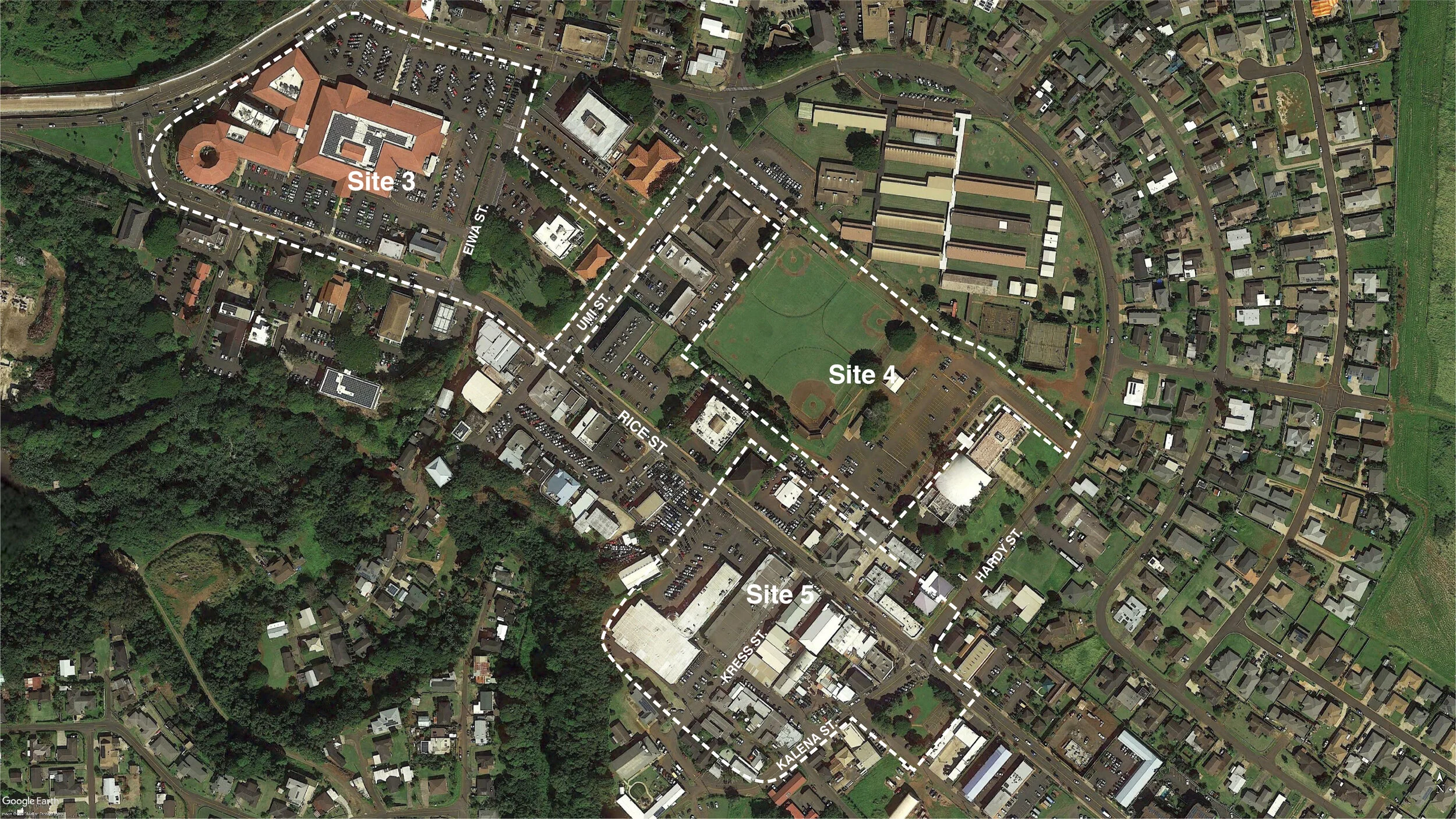
Site #3 Līhuʻe Civic Center, Eiwa Street Civic Center Historic District
Līhuʻe Civic Center
Līhuʻe Civic Center campus is comprised of County administrative offices and bounded by Kuhio Highway, Hardy Street, Rice Street, and Eiwa Street. The Līhuʻe Civic Center, once the Līhuʻe Shopping Center, the first mall on Kauaʻi, may be redeveloped as a mixed-use project including government, residential, and commercial uses through a current Request for Proposal. How space for performing and visual arts may be incorporated into this redevelopment effort could be considered in this design tank.
Līhuʻe Civic Center Historic District
The Civic Center is immediately adjacent to State Offices and the Historic County Building and Historic Lawn across Eiwa Street. The Historic County Building houses the offices and chambers of the Kauaʻi County Council. The Historic County Building, Lawn, Annex, and Old Courthouse comprise the Līhuʻe Civic Center Historic District, which is listed on the National Register of Historic Places. The County Building Lawn has been a site of community gatherings and festivals. Other buildings of state and national historic significance within proximity are the Kauaʻi Museum, located at the corner of Eiwa Street and Rice Street, and the Post Office, located across Rice Street.
Eiwa Street
Eiwa Street has been reconfigured as a transit-priority street, serving as a transit hub in Līhuʻe Town for The Kauaʻi Bus, with bus shelters and wide sidewalk. The street could also be used as a temporary “open street” connecting the Civic Center and parking lot to the Historic Lawn when the lawn is used for outdoor performances.
Site #4 Līhuʻe Civic Center to Convention Hall, Umi Street, Shared use path, and adjacent Līhuʻe ballfields
As a part of the TIGER project, a new shared use path has been constructed between the Līhuʻe Civic Center and Kauai War Memorial Convention Hall. The path goes behind Wilcox Elementary School and adjacent to the Līhuʻe Ballfields, a large park space that, prior to construction of the shared use path, was mostly concealed from public view. The ballfields, as well as the expansive parking lot behind Convention Hall, and the shared use path itself, could be considered for flexible use as performing or visual arts venues. Shared use path is shown on 2015 Tiger Grant Narrative page 21 of the PDF.
Site #5 Rice Street, Kress Street, Kalena Park
Rice Street
A primary commercial corridor in Līhuʻe, Rice Street has mixed-use including local small businesses, civic uses, residential and public space. Rice Street was recently improved through a TIGER grant with wider sidewalks and a “road diet” to support economic development and safer use for those walking, driving, and taking transit.
Kress Street
With the historic Kress Building undergoing redevelopment on the corner of Kress and Rice Streets, Kress Street could be reconfigured as a “festival street” suitable for multiple uses. What are best practices for a festival or market street?
Kalena Park
Located on the corner of Rice Street and Kalena Street, Kalena Park has functioned as a neighborhood park. With the Līhuʻe Town Core Mobility and Revitalization Project and several private redevelopment efforts breathing new life into the town core, Kalena Park has been reenvisioned as an urban park/plaza in the center of town through a master planning process initiated by youth at the Boys and Girls Club. With Kaniko‘o Senior Housing adjacent to the park and affordable family housing just down the street, Kalena Park can truly be a park for all ages. What other considerations or recommendations might you offer to the current Conceptual Plan and Vision?
Project resources
Planning documents
2020 Līhuʻe Civic Center Redevelopment RFP
2019 Kalena Park Master Plan
2018 Kauaʻi Kākou County General Plan
2015 Līhuʻe Town Core Mobility and Revitalization TIGER Grant Narrative
2015 Līhuʻe Community Plan
2009 Līhuʻe Town Core Urban Design Plan
Other environmental/historic/cultural background
Rice Street Signage Brand Guide
Rice Street logo inspiration
2017 Draft Archaeological Assessment And Cultural Assessment for Kaua‘i Museum Renovations
2012 Cultural Impact Assessment for the Kauai Community College Redesignation to Urban District
2008 Cultural Impact Evaluation for Nāwiliwili-Ahukini Bike/Pedestrian Path Project Nāwiliwili, Kalapakī and Hanamā‘ulu Ahupua‘a Līhu‘e District
Place name research - translations for nearby Hawaiian street/place names.
*All of the challenges, desired outcomes, site, and resources, including a community survey, were put together in partnership with County of Kauaʻi representatives.
Community engagement
2020 MICD Design Tank Community Survey Date Report
Drawing and image files
Site plan: Adobe Illustrator files
Site model: Rhino model
Street sections: Adobe Illustrator files
Photos
Links
http://ricestreetkauai.com/
https://www.lihuebusinessassociation.com/